


The symposium brought together over 200 leading scholars, educators, and early-career researchers from China and abroad. Focusing on the integration of artificial intelligence (AI) and mathematics education, the event featured keynote speeches, panel discussions, interdisciplinary dialogues, and parallel sessions, providing a platform for academic exchange and collaboration in advancing mathematics education in the AI era.
The opening ceremony was held on the morning of March 18. Attendees included Sun Hongpei, Vice President of BNU and Director of the Administrative Committee at BNU Zhuhai; Du Yuhong, Dean of the College of Education for the Future, BNU; Wang Kaishun, Dean of the School of Mathematical Sciences, BNU; Liang Guancheng, Director of the International Centre for Mathematics Education, BNU; and Cao Yiming, Director of the National Research Institute for Teaching Materials. Distinguished international guests included Merrilyn Goos (President of the International Commission on Mathematical Instruction, ICMI, University of Queensland), Jinfa Cai (ICMI Vice President and Professor at the University of Delaware), Betina Duarte (ICMI Vice President, National University of Teacher Education, Argentina), Mercy Kazima (University of Malawi), and Cristina Sabena (University of Turin), among others.
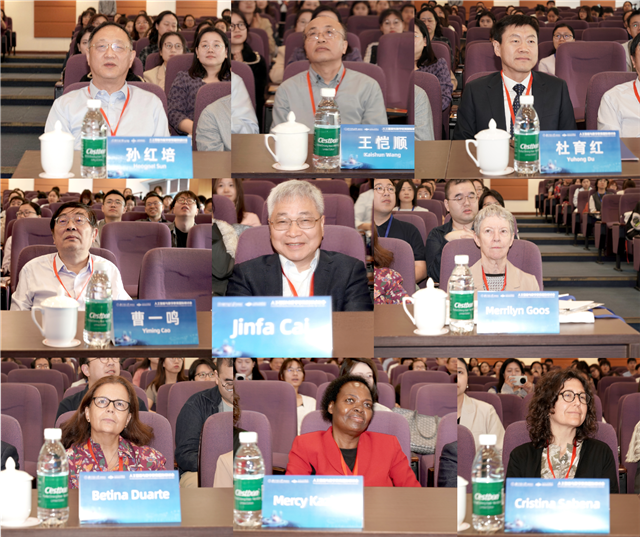
The ceremony was chaired by Liang Guancheng, who welcomed participants and highlighted the importance of international collaboration in advancing mathematics education research and innovation.
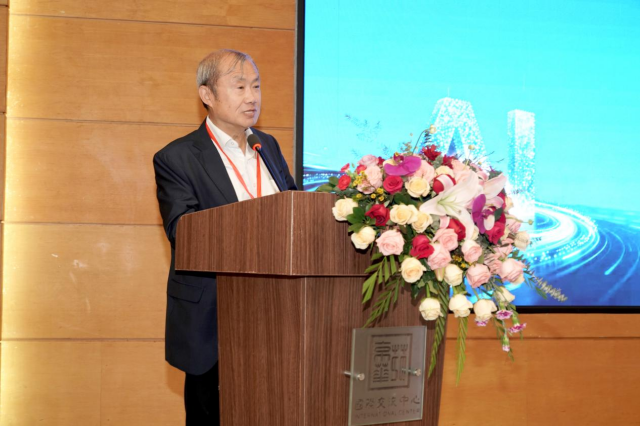
In his opening remarks, Du Yuhong emphasized the importance of exploring the integration of AI and mathematics education. He noted that BNU has been actively promoting interdisciplinary collaboration among the College of Education for the Future, the National Research Institute for Teaching Materials, and the School of Mathematical Sciences to enhance talent cultivation and educational reform. He also highlighted the establishment of the International Centre for Mathematics Education in 2024 as a step toward strengthening global engagement in this field.
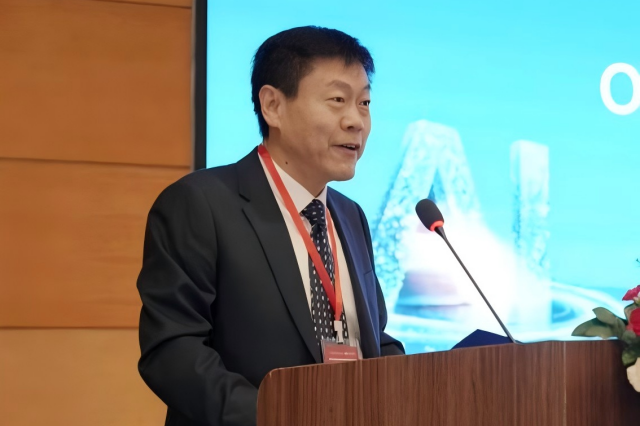
The symposium featured a wide range of academic activities addressing key issues at the intersection of AI and mathematics education.
On March 18, keynote speeches included: Merrilyn Goos on "STEM Education in the Age of AI", analyzing trends and practices in STEM education; Betina Duarte on "Technology-Supported Professional Development: Starting Point and Perspectives for a Feasible Future"; Cao Yiming on "Constructing an AI-Supported Mathematics Classroom Instruction Evaluation Framework Oriented Toward the Development of Students' Key Competencies".
On March 19, additional keynote speeches were delivered by Jean-Luc Dorier (ICMI Secretary-General) on students' spatial orientation in virtual environments, and Jinfa Cai on enhancing the impact of research on educational practice in the AI era.
A round-table forum on the afternoon of March 18 focused on "Mathematics Education in the Age of AI," featuring presentations by international experts including Mercy Kazima, Cristina Sabena, and Ramaswamy Ramanujam. The symposium also included dialogue sessions between senior scholars and young researchers, fostering in-depth discussions on current challenges and research frontiers.
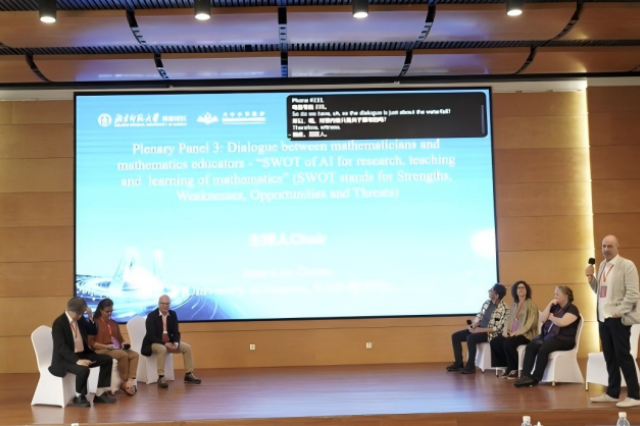
On March 19, a special dialogue between mathematicians and mathematics educators brought together leading figures such as Fields Medalist and President of the International Mathematical Union (IMU) Hiraku Nakajima, IMU Secretary-General Christoph Sorger, and Paolo Piccione from the University of São Paulo, alongside mathematics education experts. The discussion addressed the opportunities and challenges of applying AI in mathematical research, teaching, and learning.
Three parallel sessions were held on the afternoon of March 19, where participants exchanged views on recent developments and emerging trends in the field.
During the symposium, Cao Yiming presented recent achievements in mathematics textbook development, including international comparative studies and newly published research works. He also discussed approaches to integrating AI into textbook design and classroom practice.
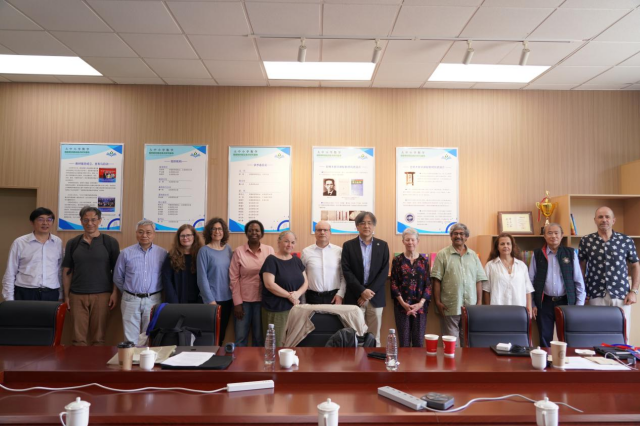
The symposium concluded with a closing address by Cao Yiming. He noted that the event facilitated in-depth international exchange and provided insights into both global trends and local practices in mathematics education. He also introduced recent progress in academic journal development by BNU's mathematics education team and upcoming international conferences, expressing hope for continued collaboration in advancing the integration of AI and mathematics education.