


Recently, Liang Yanting from the Department of Foreign Languages in the Faculty of Arts and Sciences at Beijing Normal University published a research article in the international journal Computers & Education. The paper, titled "Investigating L2 Listening Comprehension and Experience in Immersive and Interactive Virtual Reality: An Experimental Study," was co-authored with Professor Hu Guangwei, Chair Professor at The Hong Kong Polytechnic University.
The study examines the effects of immersive and interactive virtual reality (VR) environments on second-language listening performance and learner experience. Using a randomized controlled experiment combined with semi-structured interviews, the research investigates how VR-based learning environments influence listening comprehension and learners’ psychological experiences in foreign language learning.
The results show that VR environments significantly improve learners’ listening experience and indirectly enhance listening comprehension. The study further finds that the positive emotional engagement generated in VR environments plays an important role in supporting listening comprehension. This effect remains significant even after controlling for learners’ listening proficiency.
The research provides empirical evidence on the use of immersive technologies in language education and offers insights for the design of technology-supported language learning environments.
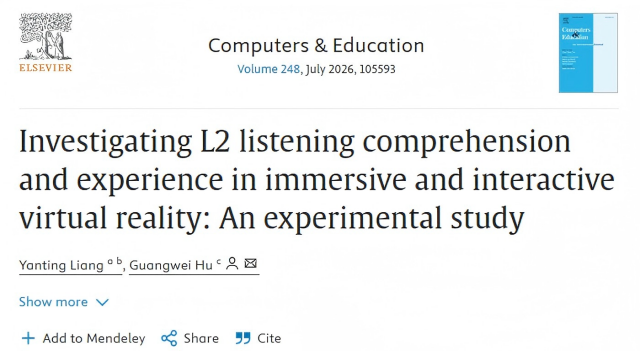
The abstract of this paper is as follows:
Listening in the real world involves both verbal and non-verbal inputs. However, second language (L2) listening activities in the classroom often lack non-verbal inputs and are removed from the situational and cultural contexts where they would naturally occur. Virtual reality (VR) technology offers the potential to create more authentic and engaging L2 listening experiences. This study examines the impact of immersive and interactive VR on L2 listening experiences (operationalized as flow) and comprehension among Chinese university-level English-as-a-foreign-language (EFL) learners. Drawing on a randomized experimental design and semi-structured interviews, the study found that while VR did not directly improve L2 listening comprehension, it contributed indirectly to L2 listening comprehension by enhancing learners' listening experiences. Furthermore, although VR enhanced listening experiences in both cognitive and affective terms, only the affective enhancement had a noticeable positive medium-sized effect on L2 listening comprehension. Cognitive benefits of VR, such as sustained concentration and heightened absorption, did not translate into better L2 listening comprehension. The observed relationships can be explained by the misalignment between VR's interactive elements and the cognitive demands of the listening task. The findings highlight the pedagogical value of VR in enhancing affective engagement in learning, underscore the need for instructional design to mitigate cognitive overload, and emphasize the importance of careful VR design to ensure that immersive features support, rather than distract from, cognitive engagement.
The full article is available at: https://www.sciencedirect.com/science/article/pii/S036013152600031X